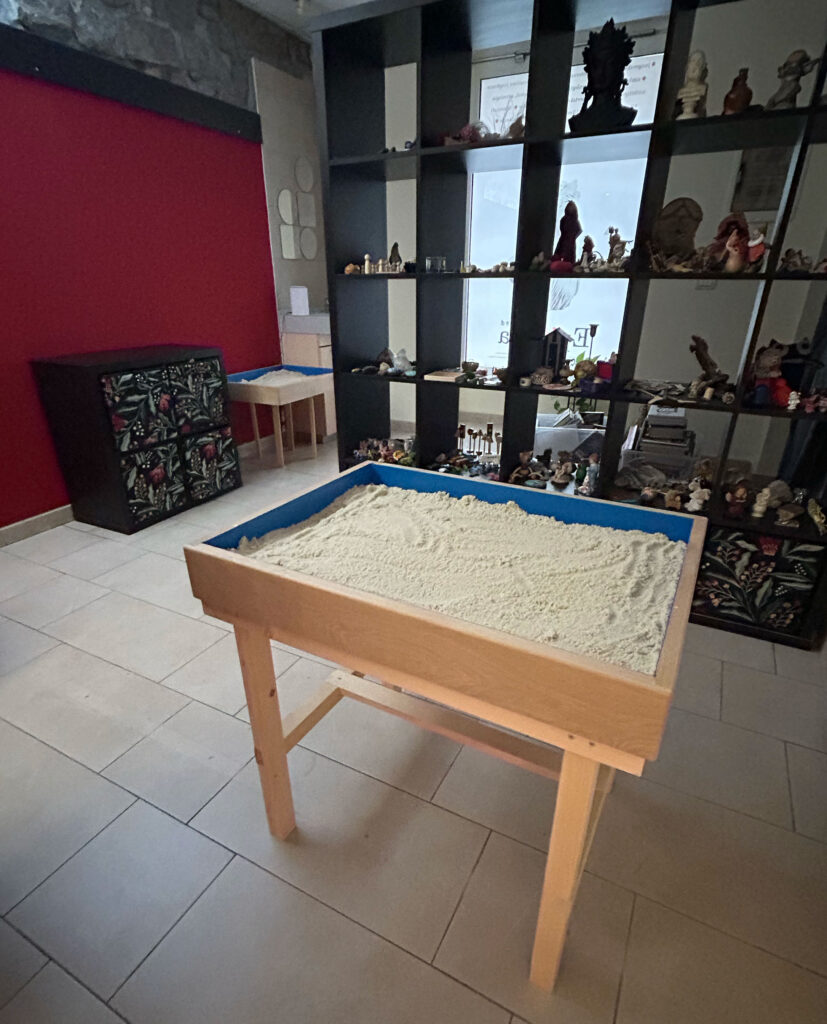
Jungian sandplay developed in the 1950s. Based on the “World Technique” of Dr. Margaret Lowenfeld, the Jungian analyst Dora Kalff further developed it through the lens of analytical psychology, with the support of Carl Gustav Jung, and named the method Sandplay.
It is grounded in the creation of a “free and protected space,” where the client, using a sandbox and miniature figures, shapes scenes from their inner world. Images often go beyond words — they reveal unconscious contents and stimulate the psyche’s natural tendency toward self-regulation and wholeness.
The therapy can be conducted on its own or alongside talk therapy, especially when words are not enough. Like dreams, the scenes in the sand carry symbolic meaning and enable a dialogue between the conscious and the unconscious.
As Sonu Shamdasani, editor of Jung’s Red Book, wrote:
“…a historical reflection shows that the spirit of Jung’s practice of images, his confrontation with his own figures, is more alive in sandplay than in other Jungian circles.” (Shamdasani, S. (2015). Jung’s Practice of the Image. Journal of Sandplay Therapy, 24, 1.)